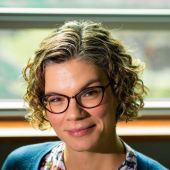
Alona Fyshe, PhD, MSc, BSc
Faculty of Science - Computing Science
Pronouns: She/her/hers
Personal Website: https://webdocs.cs.ualberta.ca/~alona/
Contact
Associate Professor
Faculty of Science - Computing Science
- alona@ualberta.ca
- Address
-
6128 University Commons
11308 - 89 Ave NWEdmonton ABT6G 2N8
Overview
Area of Study / Keywords
natural language processing neuroscience machine learning
About
I hold a Canadian Institute for Advanced Research (CIFAR) Artificial Intelligence Chair. I am a fellow of the “Learning in Machines and Brains” CIFAR Program, and a fellow of the Alberta Machine Intelligence Institute (amii). My BSc and MSc are from the University of Alberta, and my PhD is from Carnegie Mellon University.
Research
My interests are Computational Linguistics, Machine Learning and Neuroscience. My work combines all three of these areas to study the way the human brain processes language.
I use machine learning to analyze brain images collected while people read text or view images, which allows my lab to study how the human brain represents meaning. We also study how computer models learn to represent meaning when trained on text or images. We leverage the connections between computer representations of meaning and those found in the human brain in order to advance our understanding of the brain, and the state of the art in machine learning.
Teaching
I teach graduate courses on machine learning and neuroscience in both the computing science and psychology departments. In the past I have also taught upper level machine learning in computing science (466/566), psych 354 and the AI Everywhere classes (INTD 161 and 461).
Courses
CMPUT 399 - Topics in Computing Science
This topics course is designed for a one on one individual study course between a student and an instructor. Prerequisites for each section may differ and are defined by the instructor in the course outline.
INT D 461 - Artificial Intelligence Everywhere Capstone
Students from different fields, with diverse backgrounds, will have a hands-on opportunity to work in teams to apply artificial intelligence (AI) or machine learning (ML) to solve challenging problems from the community. Students will apply best practices in teamwork and communication, and reinforce how to address issues such as bias and fairness within the developed solution or analysis. Students will share interdisciplinary insights into how AI and ML can be applied across different disciplines. Prerequisites: INT D 161, and one of CMPUT 200, 300, NS 115, PHIL 250, 366, or 385. Credit cannot be obtained in both CMPUT 469 and INT D 461.
Featured Publications
arXiv. 2022 January;
Dhanush Dharmaretnam, Chris Foster, Alona Fyshe
Neural Networks. 2021 May; 10.1016/j.neunet.2020.12.009
Maryam Honari-Jahromi, Brea Chouinard, Esti Blanco-Elorrieta, Liina Pylkkänen, Alona Fyshe
PLOS ONE. 2021 March; 10.1371/journal.pone.0242754
Findings of the Association for Computational Linguistics Findings of ACL: EMNLP 2020. 2020 January;
Alona Fyshe, Gustavo Sudre, Leila Wehbe, Nicole Rafidi, Tom M. Mitchell
Human Brain Mapping. 2019 October; 10.1002/hbm.24714
Alona Fyshe, Leila Wehbe, Partha Talukdar, Brian Murphy, and Tom Mitchell
North American Chapter of the Association for Computational Linguistics - Human Language Technologies (NAACL HLT).
Haoyan Xu, Brian Murphy, Alona Fyshe
Empirical Methods for Natural Language Processing (EMNLP).
Brian Murphy, Leila Wehbe, Alona Fyshe
Language, Cognition, and Computational Models, Cambridge University Press.
Dhanush Dharmaretnam, Alona Fyshe
The North American Chapter of the Association for Computational Linguistics - Human Language Technologies (NAACL HLT 2018).
View additional publications