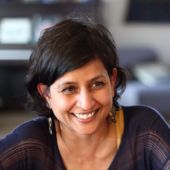
Dia Da Costa, PhD
Faculty of Education - Educational Policy Studies Dept
Pronouns: she/her
Contact
Professor
Faculty of Education - Educational Policy Studies Dept
- ddacosta@ualberta.ca
- Address
-
Education Centre - North
8730 - 112 St NWEdmonton ABT6G 2G5
Overview
About
I came to North America from India having inherited the colonial idea that we must go abroad to educate ourselves on how to be of service at home. Despite immersion in anti-imperial critiques, I pursued the seductions of colonial and nationalist ideas which taught me to see 'development' as the solution to India's problems. My undergraduate and graduate education taught me to question the powerful collaborating pedagogies inherent in 'development', nationalism, and colonialism, the links between state violence and state benevolence. Coming of age in India in the 1990s, I have spent much of my time in academia trying to understand how various communities of agricultural workers, peasants, industrial workers, and Indigenous peoples, make sense of and challenge the converging violence of neoliberal capitalist development and far right hindu fundamentalism. In the past decade, my research has focused on scrutinizing the state organized and everyday cultivation of ignorance through education, with a particular focus on caste, as one way to explain why the dominant cannot hear even though the subaltern has been speaking for so long.
I am trained in various traditions of social theory and research received on three different continents (University of Delhi, India (BA Sociology), University of Warwick, UK (MA Sociology of Education), and the US. I completed my Ph.D. in Development Sociology at Cornell University in 2003. I was Assistant Professor in the Department of Sociology and Anthropology at Hobart and William Smith colleges, a liberal arts college in upstate New York from 2004 until 2007. In the fall of 2007, I joined as Assistant Professor in the Department of Global Development Studies at Queen’s University (cross-appointed to Sociology and the Cultural Studies Program). I was a tenured Associate Professor at Queen’s until 2015 when I joined the Social Justice and International Studies in Education specialization in the Faculty of Education at the University of Alberta.
I am the author of Politicizing Creative Economy: Activism and a Hunger called Theatre (University of Illinois Press, 2016) and Development Dramas: Reimagining Rural Political Action in Eastern India (Routledge, 2009) both of which analyze state violence and state benevolence (e.g. development projects) as they interact with and shape spaces of community education, activism and cultural production in the Indian context. The organizations and activist communities that facilitated this research are Jana Sanskriti (West Bengal), Jana Natya Manch (Delhi), and Budhan Theatre (Ahmedabad). Working in solidarity with Jana Sanskriti - a theatre of the oppressed organization based in West Bengal - in the late 1990s, my initial research also resulted in an introduction to and translations from Bengali to English of a collection of community-produced plays entitled Where We Stand: Five plays from the repertoire of Jana Sanskriti (2009). Another volume I edited for the organization is called Scripting Power: Jana Sanskriti On and Offstage (2010) and celebrates 25 years of Jana Sanskriti’s local and international work in the theatre of the oppressed community. That edited book was an outcome of writing workshops with agricultural labourers in West Bengal, as well as editing and translating these writings for publication alongside essays by international theatre practitioners, activists, and scholars.
Aside from these books, I have published articles taking a critical approach to various sites of “development,” from education to creative economy and micro-insurance. Since 2014, my publicly engaged scholarship and publications have focused on the relationship of caste, colonialism and the reproduction of brahminical violence and ignorance.
Research
Research Interests:
- Feminist, Marxian, Post/Anti/Decolonial Theory
- Critical Race, Anti-Caste, Indigenous Studies
- Cultural Politics of State Violence and Development, and Nationalism
- Performance, Political Activism, and Praxis
- South Asia, South Asians in Canada
Featured publications on caste, coloniality, and castelessness:
2025 Resisting burnout: confronting white love in a brahmin mirror. RACAR. 49(1): 138-141.
2023 Writing Castelessly: Brahminical Supremacy in Education, Feminist Knowledge and Research. Meridians: Feminism, Race, Transnationalism. 22(2): 297-322.
2022 (with Shaista Aziz Patel) “‘We cannot write about complicity together’: Limits of Cross-Caste Collaborations in Western Academy,” Engaged Scholar Journal. 8(2): 1-27.
2021 Brahmanical ignorance and dominant Indian feminism’s origin stories in Leela Fernandes (ed.) Routledge Handbook of Gender in South Asia. pp. 70-84.
2019 Eating Heritage: Caste, Colonialism, and the Contestation of adivasi Creativity. Cultural Studies. 33(3). 502-526.
2018 Caste-Ignorant Worlds of Progressive Academics: Academically-Transmitted Caste Innocence in Raiot Webzine. August 24. Available online at:
Featured publications on critical development and cultural studies:
2019 (with Alexandre Da Costa) Introduction: Cultural Production under Multiple Colonialisms. Cultural Studies. 33(3). 1-27.
2019 Eating Heritage: Caste, Colonialism, and the Contestation of adivasi Creativity. Cultural Studies. 33(3). 502-526.
2019 The Perils and Possibilities of Creative Economy: A Conversation, Interview with Richa Nagar and Sarah Saddler. Agitate!: An Anti-Disciplinary Agitation.
2017 Changing Perceptions of Criminality Through Cinema. The Wire. Sep 1.
2017 “Heritage City” Ahmedabad was built through violence and exclusion. The Wire. August 11.
2016 Cruel Pessimism and Waiting for Belonging: Towards a Global Political Economy of Affect. Cultural Studies. 30(1): 1-23.
2015 Sentimental capitalism in contemporary India: Art, Heritage, and Development in Ahmedabad, Gujarat. Antipode: A Radical Journal of Geography. 47(1): 74-97.
2013 The ‘Rule of Experts’ in Making a Dynamic Micro-Insurance Industry in India. Journal of Peasant Studies. 40(5): 845-865.
2008 Tensions of Neo-liberal Development: State Discourse and Dramatic Oppositions in West Bengal. Contributions to Indian Sociology. 41 (3): 287-320.
2016 Liberating Development from the Rule of an Episteme. In Dominique Caouette and Dip Kapoor (Eds.) Beyond Development and Globalization. pp. 187-204.
2013 Laughing at the Enemy: Rethinking Critiques of Political Violence in India. In J. Smith and E. Verdeja (eds), Globalization, Social Movements, and Peacebuilding. pp. 69-93.
2012 Performing and Politicizing Education in West Bengal. In Dip Kapoor, Bijoy Barua, and Al-Karim Datoo (eds). Globalization, Culture, and Education in South Asia. pp. 155-170.
2010 Introduction: Jana Sanskriti’s Optimism of the Will and Intellect. In Scripting Power: Jana Sanskriti, On and Offstage. pp. 9-32.
2009 Introduction. In Sanjoy Ganguly, Where We Stand: Five Plays from the Repertoire of Jana Sanskriti. pp. 9-20.
Teaching
Supervisory Interests:
I encourage graduate study applications interested in decolonial, anti-caste, anti-racist, and feminist pedagogy and politics, development and cultural practice, as well as students interested in the rigorous study of colonial and post/colonial history and contemporary society, development, education and politics, as part of their graduate training.
I supervise in areas of political education, cultural production and critical cultural studies, anti-racist and anti-colonial feminist praxis, and the politics of development practice; contemporary social and cultural theory; caste, colonialism, nationalism in India and its diaspora; North America and its colonial capitalist, casteist, imperialist and nationalist relationships.
Courses Commonly Taught:
Undergraduate:
Cross-Cultural Studies in Education
International Development Education
Anti-Oppression Education
Graduate:
Feminist Theories and Epistemologies
Education and Social Change
Critical and Feminist Pedagogical Research
Courses
EDPS 411 - Cross Cultural Studies in Education
This course is an ethnographic study of the interrelatedness of educational and cultural practices and how they affect different social groups in Canadian and global contexts. It considers how cultural politics affect schooling, its outcomes, and the range of educational opportunities for different students in relation to their ethnocultural backgrounds. Examining both the historical and contemporary dynamics of schooling, the course examines how the schooling-larger culture interaction shapes the social, political, and economics dimensions of students' lives.
EDPS 422 - International Development Education
This course examines the interplay of education and international development in diverse contexts of our world. Theoretical analysis and discussions will focus on different types of education, the histories of international development and globalization, as well as citizenship, social justice and human rights education. These topical foci will be complemented by specialized regional perspectives on the state of education and social development in Africa, Asia, Latin America, Eastern Europe, the Caribbean region and Oceania.
EDPS 524 - Feminist Theories and Epistemologies
This graduate seminar introduces students to key feminist contributions to explanations for social phenomena (i.e. theory) and key feminist debates on how we know what we know (i.e. epistemology). Feminists' key contribution to epistemologies has highlighted the power relations that shape the biases which inevitably inform any and all knowledge production. The course draws on Indigenous, Black, Dalit and anti-caste, Third World, and Women of Colour feminist theories to explore the variety of epistemological challenges these pose to canonical feminist theories and considers their implications for a variety of sites of education: from classrooms to policies and activism.
EDPS 591 - Foundations of Education: Perspectives on International Issues
Critically examines the role of education in the problems and prospects of international development. As an inclusive construct, development comprises enhancements in the economic, social, political, cultural and technological well-being of people's lives. Examines contemporary societal issues that influence and/or are influenced by educational policies and programs in global contexts. Perspectives from diverse regions and groups are covered, including Africa, Asia, Latin America, Europe, the Oceania-Pacific, the Caribbean, the Middle East, and communities Indigenous to different parts of the world.
Featured Publications
RACAR-REVUE D ART CANADIENNE-CANADIAN ART REVIEW. 2024 January; 10.7202/1114517AR
MERIDIANS-FEMINISM RACE TRANSNATIONALISM. 2023 January; 10.1215/15366936-10637690
“We Cannot Write About Complicity Together”: Limits of Cross-Caste Collaborations in Western Academy
Shaista Patel, Dia Da Costa
Engaged Scholar Journal: Community-Engaged Research, Teaching, and Learning. 2022 November; 10.15402/esj.v8i2.70780
ROUTLEDGE HANDBOOK OF GENDER IN SOUTH ASIA, 2 EDITION. 2022 January; 10.4324/9781003043102-7
CULTURAL STUDIES. 2019 January; 10.1080/09502386.2019.1585463
CULTURAL STUDIES. 2019 January; 10.1080/09502386.2019.1590436
Relational Poverty Politics Forms Struggles and Possibilities. 2018 January;
CULTURAL STUDIES. 2016 January; 10.1080/09502386.2014.899607
Politicizing Creative Economy Activism and A Hunger Called Theater. 2016 January;
ANTIPODE. 2015 January; 10.1111/ANTI.12103
Globalization Social Movements and Peacebuilding. 2013 January;
JOURNAL OF PEASANT STUDIES. 2013 January; 10.1080/03066150.2013.857659
Contesting Development Critical Struggles for Social Change. 2010 January; 10.4324/9780203860922-7
CONTRIBUTIONS TO INDIAN SOCIOLOGY. 2007 January; 10.1177/006996670704100301
Globalizations. 2007 January; 10.1080/14747730701695851
View additional publications