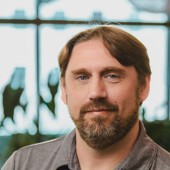
Russell Dinnage
Faculty of Science - Biological Sciences
Personal Website: https://rdinnager.github.io/dinnage_lab_website/
Contact
Assistant Professor
Faculty of Science - Biological Sciences
- dinnage@ualberta.ca
- Availability
- I am currently accepting applications from MSc and PhD students, as well as postdoctoral researchers, to join the lab at the University of Alberta. I am particularly interested in candidates with backgrounds in ecology, evolutionary biology, computer science, statistics, or mathematics who want to work at the intersection of AI and organismal biology. Undergraduate students interested in computational research are also welcome to reach out. Prospective trainees at all levels should feel free to contact me before applying.
Overview
Area of Study / Keywords
AI foundation models species distribution modeling computational ecology phenomics evolutionary biology machine learning biodiversity informatics macroevolution generative models simulation-based inference
About
My path to developing AI models for biology was not direct, which I think is part of why the work feels genuinely interesting to me. I began my research career studying how plant evolutionary diversity shapes arthropod communities -- a PhD at the University of Toronto under Peter Abrams -- and spent a substantial period of postdoctoral work working with scientists in Australia, moving between ecological metagenomics at CSIRO, macroevolutionary theory at the Australian National University, and landscape genomics at the University of Canberra. Somewhere in that trajectory, it became clear that the real bottleneck in biology was not ideas or data but tools: the methods available to ecologists and evolutionary biologists were not keeping pace with the complexity of the questions we wanted to ask.
I am now an Assistant Professor in the Department of Biological Sciences at the University of Alberta, and a fellow at the Alberta Machine Intelligence Institute (Amii). My research develops foundation models -- AI systems trained on large, heterogeneous biological datasets -- for understanding organisms and ecosystems at scales that were previously intractable. I approach this from two complementary directions: using AI to solve biological problems (what I think of as "AI for Nature"), and drawing on biological and evolutionary principles to improve AI design ("AI of Nature"). These are not separate programs so much as two faces of the same question: what can living systems and intelligent systems learn from each other?
My work has been published in Nature Ecology & Evolution, Science Advances, PLoS Computational Biology, and Methods in Ecology and Evolution, where I also serve as Associate Editor. I am committed to open science -- the models and software I build are released publicly, and I try to write documentation that is genuinely useful for researchers at all career stages.
If you are a prospective student or postdoc, what I can offer is a research environment where biological intuition and computational sophistication are both taken seriously, where the questions come first and the methods are chosen to match. The Department of Biological Sciences at Alberta has deep strengths in phylogenetics and biodiversity, and the connection to Amii means genuine access to one of the world's leading AI research communities.
Research
The central question driving my lab is: can we build AI systems that genuinely understand organismal biology -- not as a database lookup, but as a set of generalizable, transferable principles about how organisms are shaped by and respond to their environments? Foundation models have transformed natural language processing and protein structure prediction. My research explores whether the same paradigm shift is possible for ecology and evolutionary biology.
NicheFlow and species distribution modeling. Most AI tools in ecology are trained on a single species or taxonomic group and then applied narrowly. NicheFlow, one of the first foundation models for ecology, takes a different approach: it was trained across tens of thousands of species simultaneously, learning the underlying structure of environmental niches as a general phenomenon rather than a species-specific pattern. The results are qualitatively different from existing methods -- the model achieves high accuracy with only a handful of training occurrence points, and can generate predictions for species it has never seen by learning where niches tend to cluster in environmental space. This is known as in-context learning, and has deep connections to Bayesian statistical theory. Ongoing work extends this framework to more taxonomic groups, develops methods for predicting niche responses to climate change, and investigates the geometry of niche space itself.
PhenoVision and high-throughput phenomics. PhenoVision is an AI framework for detecting plant phenological events (flowering, fruiting) from field photographs, developed in collaboration with the NSF-funded Phenobase project led by Rob Guralnick and Daijiang Li. Trained on over 53 million images, it achieves 98.5% accuracy for flower detection and 95% for fruit detection across 119,000 species. The methodological innovation that made this work was "Virtual Taxonomist" pre-training: we first trained the model to identify species, then fine-tuned it for phenology detection. This outperformed standard approaches, and the parallel to evolutionary pre-adaptation -- organisms with certain ancestral phenotypes being better positioned to colonize new environments -- is not accidental. Prospective students can contribute to extensions of this work, including forecasting phenological responses to climate warming and building phenology atlases for underrepresented regions and taxa, as well as probing the model itself for insights into what it has learned and what we can learn from what it has learned.
Morphological evolution in high dimensions. Using DeepSDF neural networks trained on 3D laser scans of bird beaks from 2,020 species, I have developed a framework for analyzing morphological evolution in continuous, non-Euclidean spaces. The learned representations contain genuine ecological signal: they separate phylogenetic from functional variation and reveal that omnivores cluster with invertivores in morphological space, suggesting either transitional states or evolutionary dead-ends. This work, recently published in PLoS Computational Biology (2025), establishes the foundation for a broader program in AI-driven comparative morphology. Ongoing work will extend this to other organ systems and taxonomic groups, using museum collections as training data.
Simulation-based inference and genomics. A fourth research direction develops foundation models for population genomics and phylogenetic comparative methods using Prior-Data Fitted Networks (PFNs) -- a class of amortized Bayesian inference method that trains on simulated data and then performs inference on real data in milliseconds. Traditional inference methods for demographic history or trait evolution can take hours or days per dataset. PFN-based approaches can scale these analyses to thousands of species, and allow for much more complex models, which is increasingly necessary as genomic and macroevolutionary datasets grow in scope.
The AI of Nature. Underlying all of this is a theoretical conviction that the relationship between evolutionary biology and AI is bidirectional. The concept of pre-adaptation in evolution parallels pre-training in deep learning. Fitness landscapes and loss landscapes share structural properties that are not metaphorical but mathematical. I am developing research that treats AI models explicitly as model organisms -- studying how training history, architectural constraints, and optimization pressure shape the capabilities that emerge -- with the goal of extracting design principles for more biologically plausible and robust AI systems. At the same time, we ask: what can understanding the in silico evolution of complex computational system teach us about how biological evolution works? What parallels are there, and which parallels emerge from deeper shared principles?
Prospective graduate students and postdocs can contribute to any of these threads, or propose adjacent projects in computational or quantitative organismal biology. Experience with Python or R is expected; formal training in machine learning is helpful but not required if you have strong quantitative skills and genuine curiosity about biological questions.
Announcements
I am actively recruiting MSc and PhD students for positions starting in January or September 2027. Competitive funding packages are available through University of Alberta assistantships and fellowships. Candidates interested in AI foundation models for ecology, species distribution modeling, computational phenomics, or related areas are encouraged to apply.
Before reaching out, please review the lab website at https://rdinnager.github.io/dinnage_lab_website/ and the graduate admissions information for the Department of Biological Sciences. Send a CV, a brief description of your research interests, and any relevant writing samples to my University of Alberta email address with the subject line "Graduate Position - [Your Name]."
Postdoctoral candidates are also welcome to reach out to discuss potential projects and fellowship opportunities.
Courses
BIOL 221 - Mechanisms of Evolution
Discusses the major features of the evolutionary process, including the fossil record, basic population genetics, variation, natural selection, adaptation, and speciation. Prerequisites: BIOL 107 and 108. Credit cannot be obtained for both BIOL 221 and 321.
CMPUT 499 - Topics in Computing Science
This topics course is designed for a one on one individual study course between a student and an instructor. Prerequisites for each section may differ and are defined by the instructor in the course outline.
Featured Publications
Erin L. Grady, Ellen G. Denny, Carrie E. Seltzer, John Deck, Daijiang Li, Russell Dinnage, Robert P. Guralnick
2025 September; 10.1101/2025.09.26.678778
Russell Dinnage, Erin Grady, Nevyn Neal, Jonn Deck, Ellen Denny, Ramona Walls, Carrie Seltzer, Robert Guralnick, Daijiang Li
Methods in Ecology and Evolution. 2025 August; 10.1111/2041-210X.70081
Journal of Ecology. 2025 April; 10.1111/1365-2745.70015
Russell Dinnage, Marian Kleineberg
PLOS Computational Biology. 2025 March; 10.1371/journal.pcbi.1012887
Russell Dinnage
2024 October; 10.1101/2024.10.15.618541
Proceedings of the Royal Society of London. Biological Sciences. 2024 October; 10.1098/rspb.2024.1905
Russell Dinnage, Stephen D. Sarre, Richard P. Duncan, Christopher R. Dickman, Scott V. Edwards, Aaron C. Greenville, Glenda M. Wardle, Bernd Gruber
Molecular Ecology Resources. 2024 April; 10.1111/1755-0998.13916
Molecular Ecology. 2023 December; 10.1111/mec.17174
Russell Dinnage
2023 June; 10.1101/2023.06.12.544623
F. F. Machado, L. Jardim, R. Dinnage, D. Brito, M. Cardillo
Animal Conservation. 2023 June; 10.1111/acv.12823
Science Advances. 2023 April; 10.1126/sciadv.adg6175
Current Biology. 2023 April; 10.1016/j.cub.2023.02.063
Nature Ecology and Evolution. 2022 February; 10.1038/s41559-021-01604-y
Alexander Skeels, Russell Dinnage, Iliana Medina, Marcel Cardillo
Evolution Letters. 2021 June; 10.1002/evl3.225
Nature human behaviour. 2021 February; 10.1038/s41562-020-01039-8
Daijiang Li, Russell Dinnage, Lucas A. Nell, Matthew R. Helmus, Anthony R. Ives
Methods in Ecology and Evolution. 2020 November; 10.1111/2041-210X.13471
Russell Dinnage, Alexander Skeels, Marcel Cardillo
Proceedings of the Royal Society B: Biological Sciences. 2020 May; 10.1098/rspb.2019.2817
View additional publications
Research Students
Currently accepting undergraduate students for research project supervision.
Undergraduates interested in computational biology, machine learning applications in ecology, or data analysis in evolutionary biology are welcome to reach out. Opportunities may include contributing to ongoing projects in species distribution modeling, image-based phenomics, or morphological analysis. Prior experience with R or Python is an asset but not a firm requirement for students who are motivated to learn. I am currently seeking someone with interest and skills in agentic AI systems to help develop agentic AI for accelerating scientific discovery in organismal biology. To inquire, send a brief email describing your background and interests along with an unofficial transcript.